The Small Job Tax: How Spark Cold Starts Are Silently Draining Your Data Budget

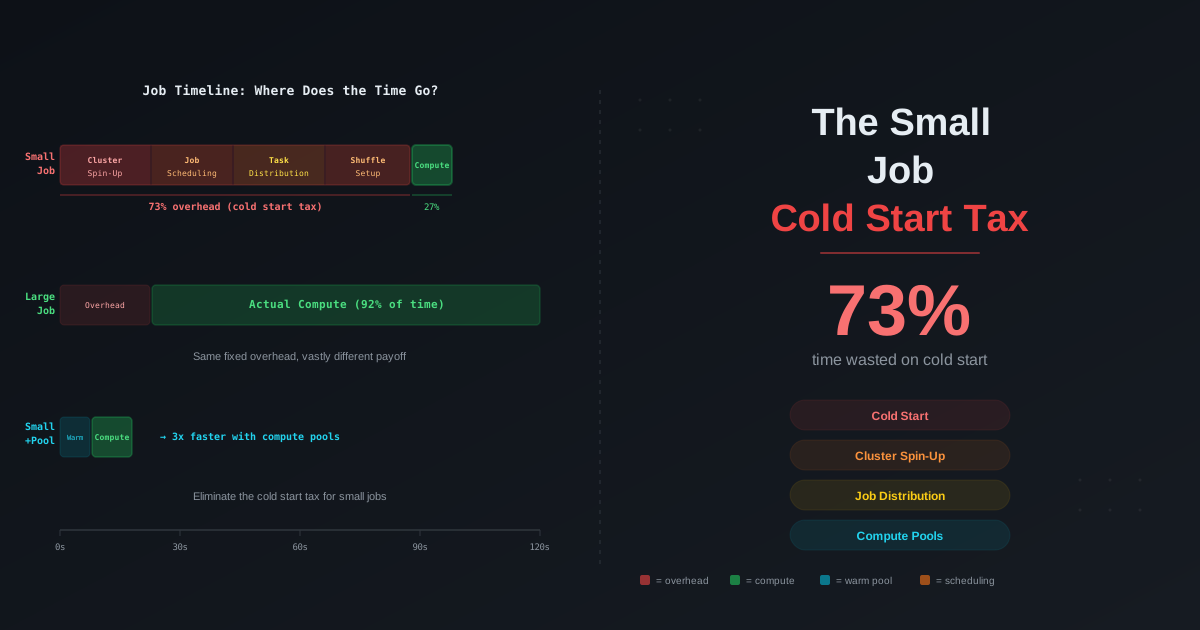
Most data teams obsess over optimizing their biggest, most complex Spark jobs. Meanwhile, hundreds of tiny ETL jobs — each processing a few gigabytes — quietly rack up a bill that nobody questions.
We call it the Small Job Tax: the disproportionate cost of running lightweight workloads on infrastructure designed for heavy lifting. And for many organizations, it is the single largest source of wasted compute spend.
The Uncomfortable Truth About Your Job Distribution
Pull up your Spark job history from the last 30 days. Plot the jobs by input data size. What you will likely see is something like this:

| Input Size | % of Total Jobs | % of Total Compute Spend |
|---|---|---|
| Under 1 GB | 40-50% | 15-25% |
| 1-10 GB | 25-35% | 20-30% |
| 10-100 GB | 15-20% | 25-35% |
| Over 100 GB | 5-10% | 25-35% |
The bottom two rows — jobs processing under 10 GB — often account for 65-85% of all job executions in a typical data platform. Each one is small. Each one feels cheap. But collectively, they are bleeding your budget because of a structural problem: they pay the same infrastructure overhead as the big jobs, but process a fraction of the data.
Anatomy of a Cold Start: Where Your Money Actually Goes
When a Spark job launches on a fresh cluster, the clock starts ticking long before your first line of business logic executes. Here is what happens:
Phase 1: Cluster Provisioning (60-300 seconds)
The platform requests compute resources. On Databricks, this means spinning up a job cluster. On EMR, it means provisioning EC2 instances. On Kubernetes, it means scheduling pods and attaching storage.
- Cloud VM allocation: 30-120 seconds depending on instance type and availability
- Container image pull: 15-60 seconds for Spark runtime images
- Storage provisioning: EBS volumes or PVCs get created and attached
- Network configuration: Security groups, VPC endpoints, DNS resolution
You are billed for all of this time. Your data has not moved a single byte yet.
Phase 2: Spark Runtime Bootstrap (15-45 seconds)
Once the machines are up, the Spark runtime needs to initialize:
- JVM startup and class loading: 5-10 seconds
- SparkContext initialization: 5-15 seconds
- Executor registration with the driver: 5-15 seconds
- Dynamic allocation negotiation: 5-10 seconds (if enabled)
Phase 3: Your Actual Job (variable)
Finally, your code runs. For a 2 GB CSV-to-Iceberg transformation, this might take 30-90 seconds. The job itself is fast. Everything before it was not.
The Real Timeline
For a typical small ETL job:
|-- Cluster Provisioning --|-- Spark Bootstrap --|-- Actual Work --|
        2-5 minutes              15-45 sec           30-90 sec
Your actual work is often less than 25% of the total billed duration. The rest is overhead — and you pay for every second of it.
The Math: What the Small Job Tax Actually Costs
Let us calculate the tax for a real-world scenario.
Scenario: Mid-Size Data Team on Databricks
Assumptions:
- 200 small jobs per day (each processing under 5 GB)
- Average cluster cold-start time: 4 minutes
- Average job runtime after startup: 3 minutes
- Job cluster cost: $0.40/DBU-hour on an i3.xlarge (Jobs Compute)
- Cluster size: 1 driver + 2 workers = ~3 DBUs
Daily cold-start waste:
200 jobs x 4 min cold start x (3 DBU x $0.40/hr) / 60 min
= 200 x 4 x $0.02
= $160/day in pure cold-start overhead
Daily actual compute:
200 jobs x 3 min runtime x (3 DBU x $0.40/hr) / 60 min
= 200 x 3 x $0.02
= $120/day for actual work
The tax rate: you are paying $160 to get $120 of work done. That is a 133% overhead.
Annualized, that cold-start waste alone is $58,400 per year — and this is just one team's small jobs.
Scenario: Platform Team on EMR / EKS
Assumptions:
- 500 small jobs per day across multiple teams
- Average pod scheduling + Spark startup: 2.5 minutes
- Average job runtime: 2 minutes
- EKS cost per job (instances + EBS): $0.006/minute for a small cluster
Daily cold-start waste:
500 jobs x 2.5 min overhead x $0.006/min = $7.50/day
That may sound small per job. But the runtime cost is only:
500 jobs x 2 min x $0.006/min = $6.00/day
The overhead exceeds the compute again. And at $7.50/day in pure waste across 365 days, that is $2,737/year — just from scheduling and bootstrap delays on jobs that each process a few gigabytes.
Scale that to thousands of jobs across an enterprise, and the numbers start looking like headcount.
Why This Problem Is Getting Worse
Three industry trends are compounding the Small Job Tax:
1. Microservice-Driven Data Architectures
As organizations decompose monolithic pipelines into smaller, domain-owned jobs, the total number of small jobs explodes. A single nightly batch that processed 500 GB becomes 50 domain-specific jobs processing 2-10 GB each. Each one pays the cold-start tax independently.
2. Event-Driven and Real-Time Pipelines
The shift from daily batch to hourly or near-real-time processing means the same data volume gets split across more frequent, smaller jobs. A job that ran once and processed 100 GB now runs 24 times and processes 4 GB each run. The data volume is the same. The cold-start cost is 24x.
3. Rising Infrastructure Complexity
Cloud compute costs are not falling as fast as data volumes are growing. The cost per cold start stays roughly constant while the number of cold starts multiplies. Add container orchestration layers, security scanning, and compliance checks, and the bootstrap overhead only increases.
The Hidden Multipliers You Might Be Missing
The cold-start minute cost is only the most obvious part of the tax. There are secondary costs that rarely show up in dashboards:
Overprovisioned resources. Most small jobs inherit cluster templates designed for larger workloads. A 2 GB job running on a cluster with 64 GB of memory and 16 cores is paying for resources it will never touch.
Minimum billing increments. Many platforms bill in 1-minute or even 10-minute increments. A job that finishes in 90 seconds gets billed for 2 or 10 minutes.
Storage churn. Each job cluster creates and destroys EBS volumes or PVCs. This creates I/O costs and, in Kubernetes environments, can cause scheduling delays that cascade into other jobs.
Small file proliferation. Short-lived jobs with small inputs tend to write small output files. Over time, this degrades downstream read performance and creates compaction debt that someone else has to pay for.
Five Approaches to Kill the Small Job Tax
1. Right-Size Your Clusters for the Job, Not the Template
Stop using one-size-fits-all cluster configurations. A 2 GB job does not need 3 m5.2xlarge instances. Create dedicated small-job profiles:
- 1 driver with 1-2 vCPUs and 2-4 GB memory
- 2-4 small executors matching the data volume
- Aggressive dynamic allocation to release unused executors quickly
This alone can cut per-job cost by 40-60% — but it does not eliminate cold starts.
2. Use Warm Pools and Session Reuse
Instead of provisioning a fresh cluster for each job, route small jobs to pre-warmed compute pools that stay alive across multiple executions. A persistent warm pool can serve many jobs sequentially or concurrently, eliminating the per-job bootstrap overhead entirely.
The cold start drops from minutes to zero. The pool's idle cost is amortized across hundreds of jobs.
3. Implement Workload-Aware Routing
Not every job should take the same path. Build a routing layer that inspects job metadata before execution:
- Input size under 10 GB and no global sort and broadcastable joins — route to a warm pool
- Everything else — route to a dedicated job cluster
Add safety valves: if a pooled job exceeds runtime or memory thresholds, automatically requeue it to a full cluster. This keeps the pool efficient and prevents runaway jobs from impacting others.
4. Tune Defaults for Small Data
Spark's defaults assume large-scale distributed processing. For small jobs, many of those defaults are wasteful:
spark.sql.shuffle.partitions: Default is 200. For a 2 GB job, you need 2-4 partitions. Over-partitioning creates scheduling overhead and tiny output files.spark.sql.autoBroadcastJoinThreshold: Increase this generously (e.g., 256 MB). If one side of a join fits in memory, avoid the shuffle entirely.spark.sql.adaptive.enabled: Turn this on. AQE dynamically coalesces partitions and optimizes joins at runtime.
5. Coalesce Writes and Schedule Compaction
Small jobs writing small files is a downstream tax on everyone who reads that data. Force output coalescing to produce fewer, larger files (512 MB-1 GB per file for Iceberg tables). Schedule regular compaction to merge small files after the fact.
This is not just about storage efficiency — it directly reduces the compute cost of every query that touches that data downstream.
How Cazpian Eliminates the Small Job Tax
Cazpian's compute architecture is designed from the ground up to solve this exact problem:
Serverless Spark Compute. You do not provision clusters. Cazpian manages warm compute pools that serve your jobs with zero cold start. Small jobs start executing immediately on right-sized resources.
Usage-Based Billing. You pay for compute hours actually consumed — not for cluster startup, not for idle time, not for overprovisioned memory. When a 2 GB job takes 45 seconds of compute, you pay for 45 seconds.
Intelligent Resource Allocation. Cazpian's platform automatically right-sizes compute for each job based on input volume, shuffle estimates, and historical patterns. A small ETL job gets small executors. A large aggregation gets the resources it needs. No templates to manage.
Built-in File Hygiene. Coalesced writes and scheduled compaction are native to the platform, not something your team has to build and maintain. Your Iceberg tables stay performant without manual intervention.
Data Stays in Your AWS. All compute runs in your VPC. You get the cost efficiency of a managed platform without the data sovereignty trade-offs.
Measure Your Own Small Job Tax
Before you optimize, quantify the problem. Here is a quick diagnostic:
- Export your job history for the last 30 days with start time, end time, input bytes, and cluster configuration.
- Plot the CDF of input sizes. What percentage of jobs process under 10 GB?
- Calculate cold-start overhead per job. Subtract actual Spark task execution time from total cluster uptime.
- Multiply by cost per minute. This is your Small Job Tax.
Most teams that run this analysis find that 20-40% of their total Spark compute spend is paying for infrastructure overhead on jobs that do not need it.
What is Next
This is Part 1 of our series on cutting lakehouse compute costs. In Part 2, we will dive deep into Cazpian Compute Pools — the architecture behind zero-cold-start Spark execution and how it can cut your compute bills in half.
Have questions about optimizing your Spark compute costs? Reach out to the Cazpian team — we would love to help you calculate your Small Job Tax.